

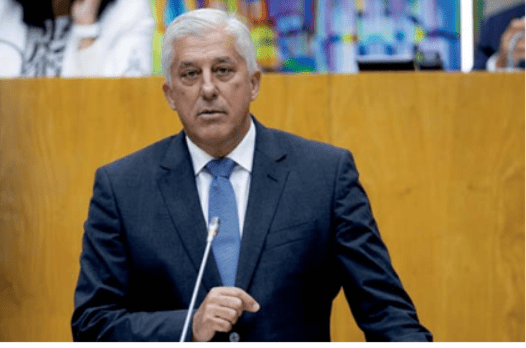
The Regional Secretary for Finance, Planning, and Public Administration, Duarte Freitas, yesterday defended in the Azores Parliament a “prudent financial policy that maintains low taxes” as a mechanism to stimulate economic growth, while ensuring balanced accounts and the capacity to invest. Duarte Freitas acknowledged that the “current situation is paradoxical,” with ‘historic’ indicators, but “also a huge challenge of budgetary sustainability.” He emphasized: “It is precisely now that we must act, because the worst mistake would be to wait for stagnation or crisis to correct imbalances. We cannot waste this opportunity. It is time to make budgetary adjustments while the economy is growing.”
“I can note here that the 14th Government of the Azores will present, within a maximum period of one month, a savings plan with a set of measures that will allow, as early as 2026, savings in the Regional Budget of more than €30 million,” he said, speaking at the Legislative Assembly of the Autonomous Region of the Azores. He specified that these measures include a 20% reduction in office and consulting expenses and an equal reduction in travel and accommodation, studies and opinions, seminars, and exhibitions. “This plan also includes measures for the effective monetization of regional assets, with an impact of more than €2 million by 2026,” he added.
“The Azorean economy is doing well, it is strong and is recommended,” emphasized the Regional Secretary, who presented several indicators that attest to this premise: the Economic Activity Indicator has been growing for 50 consecutive months and the Private Consumption Indicator for 52 straight months, and even with the reduction in taxes, revenue has grown significantly. “Total main taxes rose from around €541 million in 2019 to €681 million in 2024, an increase of 26%,” he explained. In the second quarter of 2025, the unemployment rate reached “a historic low of 3.9%,” the best figure since 2007, while in 2024, 4.39 million overnight stays in tourism were achieved, “a growth of 45%, and €188 million in revenue, 80% more than five years ago.” He continued: “Although the update of the statistical series has postponed this goal by one year, in 2025, the Region will exceed the €6 billion GDP mark, something unthinkable a few years ago. In 2019, it was €4.349 million, according to the same statistical basis as the 2021 series. These figures prove that the economy is generating wealth, income, and consumption.
The Azores economy is stronger than ever. This is due to the efforts and success of businesses and families.” Duarte Freitas then listed some of the measures taken by the PSD/CDS-PP/PPM coalition governments that had a “clear positive impact on the pockets of the Azoreans,” such as “tax cuts, which took hundreds of millions of euros out of the region’s coffers” but “returned and stimulated income to families and businesses.” The minister also recalled the success of the “Azores Tariff,” which means that €13.5 million will have to be invested this year, compared to the initial cost of €6 million. On the other hand, he warned, the increase in transfers to health and education made it possible to pay for the recovery of teachers’ service time and the valorization of health careers. “These are achievements of this government, fulfilling justice previously denied. In education, transfers grew by 45% between 2019 and 2025. In health, around 80%. Salary increases between 2024 and 2025 represent more than €52 million, of which €32 million is for the teaching profession. All of this, of course, increases the pressure on the Region’s budget,” he said.
In Diário dos Açores, Paulo Viveiros-director.
Translated into English as a community outreach program by the Portuguese Beyond Borders Institute (PBBI) and the Modern and Classical Languages and Literatures Department (MCLL), in collaboration with Bruma Publication and ADMA (Azores-Diaspora Media Alliance) at California State University, Fresno. PBBI thanks Luso Financial for sponsoring NOVIDADES.

 Novidades - The Islands and the Diaspora