

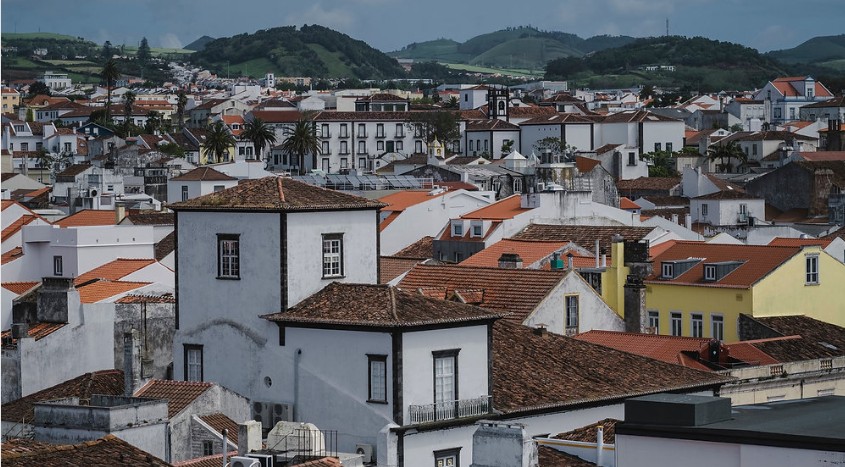
The seminar ‘The housing crisis in the Azores’ kicks off next Wednesday, September 10, in Ponta Delgada, and runs until Friday, with a conference, field visits, and four workshops. The first day includes sessions on social responses for homeless individuals, led by the Novo Dia association, and on the experiences of those seeking housing, featuring activists from Habitat-Açores. The main conference will take place on Thursday in Auditorium 8 of the University of the Azores. At the same time, the last day will include a tour of the Rabo de Peixe housing neighborhoods and two workshops dedicated to social reintegration and the stigma of exclusion.
According to Paulo Fontes, from the Center for Humanistic Studies at the University of the Azores, the housing crisis in the region worsened from 2015 onwards, when the growth of tourism brought with it a process of “touristification,” as he puts it. “This phenomenon caused widespread real estate speculation and made houses unaffordable for most people, the middle class, and young people. Young people are extremely concerned because they cannot buy a home and renting is also very difficult,” he explains.
“Social housing in the Azores is almost a mirage. We have one of the lowest construction rates per thousand inhabitants in Europe,” he says, emphasizing that this deficit is compounded by structural weaknesses: “In addition to being the poorest region in the country, one of the poorest in Europe, we have the lowest social housing rates and a huge problem with real estate speculation. We have several conditions that greatly affect the housing problem in the Azores.”
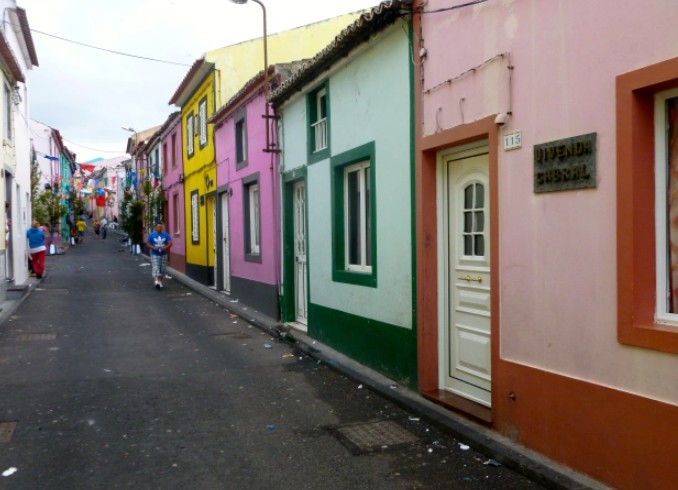
The seminar he is now organizing is the result of a collaboration between universities and civil society associations. Paulo Fontes explains that “at the right time, a group of academics, but also associations, decided to come together,” bringing together the Center for Humanistic Studies of the University of the Azores, the Interdisciplinary Center for Social Sciences of the University of the Azores and the New University of Lisbon, Dinamia’CET-Iscte, the Novo Dia Association, the Order of Architects, Habitat-Açores, and the CARE(4)HOUSING project, funded by FCT. Among the guests will be Luís Mendes, leader of this project and professor at the University of Lisbon, and architect Helena Roseta, who collaborated in the drafting of the current basic housing law.
Among the main topics under discussion, Paulo Fontes highlights the right to housing, especially in terms of what it reveals about the choices made at the level of public policy: “One of the main concerns of this seminar will be precisely the right to housing, which is enshrined in the Constitution but is not guaranteed by public policies in our country or in the region. We hope that it will be a fruitful discussion for the development of public policies that can change this situation. We know that the housing problem cannot be solved overnight, it is structural, but we need to start investing consistently, now,” he says.
Other issues that will be on the table will have to do with “urbanization, the gentrification of cities, the rehabilitation or not of heritage and existing buildings, and also the construction of new housing. We have several topics, some more focused on housing, others more cross-cutting, because housing affects the whole of society,” explains Paulo Fontes. “The housing crisis is also fueling populist movements and people’s anger at not being able to access housing. And the issue of homelessness is central, because these are the people who are most excluded in terms of housing. They are at the end of the line and are among those most affected by this speculation and this major crisis,” he adds.
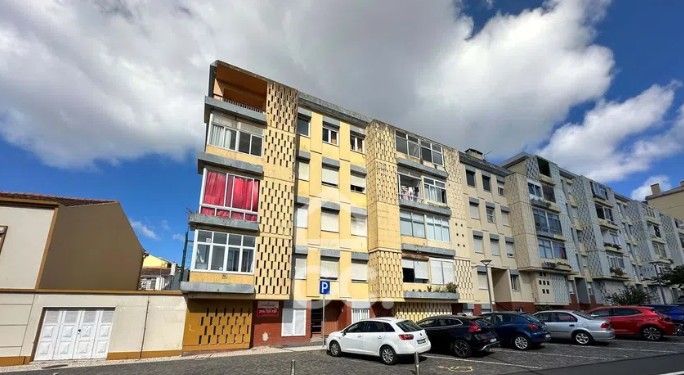
As for expectations and repercussions in future discussions on the housing crisis in the region, the professor emphasizes that “this seminar is a way of connecting academia and society in the face of a central problem in the Azores. Our ambition is to promote constructive debate so that it can inform government officials and public policies in a more sustainable way. We hope that the population will join in and come to discuss these current housing problems with experts, associations, and researchers,“ he said.
Among the presentations that will take place this Wednesday will be that of the Novo Dia Association, represented by Hélder Fernandes and Dário Relva, who will present the work they have done with homeless people and focus on the ”Housing First” model.
Hélder Fernandes, psychologist at Associação Novo Dia, argues that it is necessary to link this reality to other issues, noting that “in the first instance, a homeless person is someone who does not have a home, a roof over their head, an address. And although the issue of housing is not a problem that only affects homeless people, it is in fact one of the most serious forms of social and housing exclusion,” he says. According to the association’s data, in the municipality of Ponta Delgada alone, there were 156 homeless people in the last survey conducted, a number that may be higher, given that there may be other cases that are not reported by the association.
Hélder Fernandes emphasizes that “the lack of housing plays a central role both in the risk of entering this condition and in the difficulty of getting out of it. Without accommodation solutions, without housing solutions, these people will always find themselves in this situation.“
”There has been a lot of talk about people who are homeless because they are in unsuitable or inadequate places. But this should also make us reflect. These people are not in this situation by choice, but because there are no solutions. People have no choice but to spend the night in unsuitable places that offer neither dignity nor safety,“ he adds.
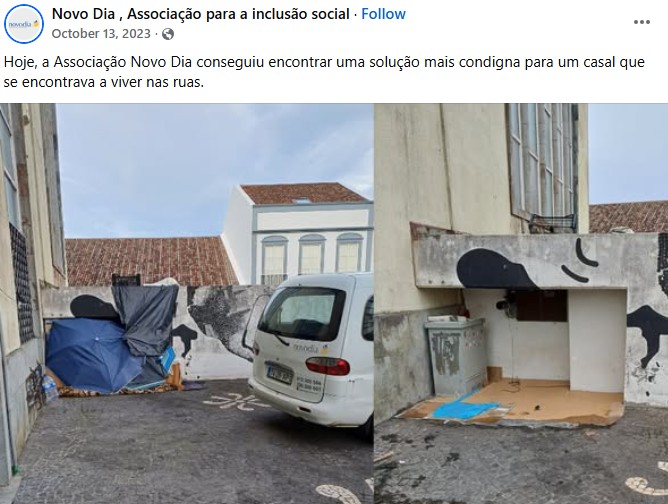
Novo Dia’s presence at the seminar also aims to highlight good practices and alternative models: ”There will be a reflection on the different solutions that can help alleviate this situation, including, for example, investment in ‘Housing First’. But it will be a broader reflection, not restricted to people in this condition,“ he says. For Hélder Fernandes, ”it is important that this issue is discussed and that people with knowledge of the measures and policies that have been adopted are brought in to try to find solutions to this situation that the community is experiencing. The aim is to reflect and find answers that meet the needs of society. On the other hand, it is also to publicize the work that has been done and the good practices adopted at the international, national, and local levels,” he concludes.
Daniela Canha is a journalist for Correio dos Açores. Natalino Viveiros, director.
Translated into English as a community outreach program by the Portuguese Beyond Borders Institute (PBBI) and the Modern and Classical Languages and Literatures Department (MCLL), in collaboration with Bruma Publication and ADMA (Azores-Diaspora Media Alliance) at California State University, Fresno. PBBI thanks Luso Financial for sponsoring NOVIDADES.

 Novidades - The Islands and the Diaspora