

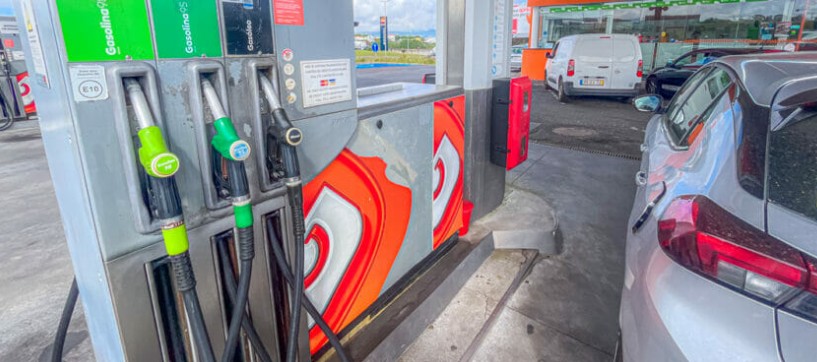
The Atlantic does not shout when it tightens its grip—it presses quietly, steadily, until the cost of distance is felt in every household ledger. In the Azores, that pressure now arrives at the pump.
Fuel prices across the archipelago are set to rise sharply in May, a direct consequence of shifting global conditions rippling outward to Europe’s far western edge. According to figures reported by Antena 1, the increases are not incremental—they are striking.
Diesel fuel, the backbone of transportation and daily life across the islands, will jump by 36.3 cents per liter. Gasoline (95 octane) follows with an increase of 21.7 cents per liter. Even liquefied petroleum gas—essential for cooking and heating—will rise by 36.9 cents per kilogram.
These new prices take effect Friday, May 1, reshaping the economic rhythm of island life.
Under the revised pricing structure:
- Gasoline (95 octane) will cost €1.921 per liter
- Diesel will reach €2.004 per liter
- Agricultural diesel will be priced at €1.633 per liter
- Diesel for artisanal and small-scale fishing will stand at €1.443 per liter
For liquefied gases:
- Butane (26L or larger cylinders): €2.208 per kg
- Butane (lightweight 24L cylinders): €2.408 per kg at point of sale
- Piped butane: €2.208 per kg at consumption site
- Bulk butane: €1.801 per kg at industrial facilities
In continental markets, such increases might register as another fluctuation in a volatile energy cycle. But in the Azores, geography amplifies every shift. Distance is not an abstraction—it is a cost structure. Every liter carries the weight of transport, logistics, and dependency on external supply chains.
The result is more than a price adjustment; it is a reminder of structural vulnerability. Fuel in the islands is not merely a commodity—it is mobility, agriculture, fishing, and survival. When diesel crosses the €2 threshold, it reverberates through every sector, from the farmer turning soil to the fisherman reading the tides.
There is, in these numbers, a familiar tension. The global and the local meet not in policy debates, but in daily necessity. The price posted at the pump becomes the most immediate translation of distant conflicts, market shifts, and geopolitical uncertainty.
And so, once again, the Azores absorb the world—not through headlines, but through cost.
In Correio dos Açores- Natalino Viveiros, director

 Novidades - The Islands and the Diaspora